
Sistema de blogs Diarium
Universidad de Salamanca
María Jesús Santos Sánchez
Facultad de Ciencias - Departamento Física Aplicada
 
Jardines
Archivos de Etiquetas | IUFFyM

Nevo: illuminating the dark cosmos – Farbod Hassani

Title: Nevo: illuminating the dark cosmos 

Speaker: Farbod Hassani (University of Oslo)

Abstract:

The Universe has entered an accelerating expansion phase in the last few billion years of its evolution, a phenomenon that is caused by the mysterious entity known as dark energy.
To understand the nature of dark energy, we must carefully investigate different candidates and observe how they affect the Universe at various stages. Then we may utilize data to select the best candidate. However, the consistent and accurate modeling of dark energy candidates has been largely neglected so far due to significant challenges, including the absence of relativistic N-body codes, the immense computational costs involved, and the limited availability of relevant data to date. To address this gap, we have proposed the development of a novel framework, called NEVO, that utilizes state-of-the-art “relativistic” N-body simulations along with the advanced Boltzmann codes, to accurately model dark energy candidates in both linear and non-linear scales. In this presentation, I will go into detail about the awarded NEVO proposal and discuss its challenges in depth.
Wednesday 19th, 11:30, Aula VII  del Edificio Trilingüe – Faculta de Ciencias Universidad de Salamanca
Comentarios { 0 }

GeoGebra Discovery a tool based on symbolic computation for automated reasoning in Elementary Geometry

pilar-velez-melon-600x350

Pilar Vélez Melón

GeoGebra Discovery a tool based on symbolic computation for automated reasoning in Elementary Geometry

M. Pilar Vélez

Universidad Antonio de Nebrija 

GeoGebra Discovery is a fork version of the dynamic geometry system GeoGebra that provides GeoGebra with the ability to automatically conjecture, discover and prove Geometry statements from a plane construction. The algorithms behind these features are based on complex and real algebraic geometry. 

In this talk we introduce, first the current performance of the program GeoGebra Discovery regarding some automatic reasoning tools features. Then we focus on the computational algebraic geometry methods used, mostly in the complex setting, and some pending theoretical and algorithmic issues to extend (in the same technological and educational framework) such methods to deal with Geometry statements in the real algebraic geometry context.

https://github.com/kovzol/geogebra-discovery

Date: Friday, January 17th, 2025

Time: 13:00

Place: Aula I Trilingüe

Comentarios { 0 }

Dynamical and statics interference effects in photonic lattices Pedro Orellana

pedritoSeminar: Dynamical and statics interference effects in photonic lattices

Pedro Orellana Universidad Técnica Federico Santa María (Chile)

Date: 17/12/2024

Time: 13:00 h

Place: Aula V Trilingüe, Facultad de Ciencias, Universidad de Salamanca

In this seminar, we will analyze some interference effects due to side-attached structures in onedimensional photonic lattices. We will examine the dynamic and static properties of Fano resonances and bound states in the continuum in these systems [1-2].

References

[1] E. Miroshnichenko, S. Flach, and Y. S. Kivshar, Fano resonances in nanoscale structures, Rev.

Mod. Phys. 82, 2257 (2010)

[2] C. Hsu, B. Zhen, and A. e. a. Stone, Nat. Rev. Mater.1, 16048 (2016)


Comentarios { 0 }

Taming gauge symmetry with quantum computers

ABermudezIII Colloquium IUFFyM 2024/2025 

Taming gauge symmetry with quantum computers

Alejandro Bermúdez Carballo Instituto de Física Teórica, CSIC-UAM

Date: December 12th, 2024

Time: 13:00 h

Place: Aula I Trilingüe, Facultad de Ciencias, Universidad de Salamanca

The notion of gauge symmetry underlies our most accurate descriptions of the fundamental laws of Nature. In contrast to global symmetries, which transform quantum states in a prescribed manner and can be spontaneously broken leading to the variety of states of matter that surround us, gauge symmetry is often referred to as a ‘do-noting transformation’. Indeed, it acts trivially on physical quantum states, and is thus understood as some sort of redundancy as only gauge-invariant observable es can display a non-vanishing expectation value. In this talk, I will discuss recent progress in the field of quantum computation and quantum simulation that is progressively allowing to synthesize lattice field theories (sLFTs) in several laboratories worldwide. In this experiments, gauge symmetry is not a redundancy but rather an emergent approximate symmetry acting non-trivially on the whole Hilbert space of the system. I will show how one can use these quantum devices to explore problems such as confinement by designing the effective dimensionality and the gauge group of these sLFTs, and point to future exciting directions in which open problems in the field, revolving around the finite-density phases of quark matter or real-time non-equilibrium phenomena, could be addressed with these quantum devices.

Comentarios { 0 }

Creación de material personalizado, evaluación automática con IA y redes de microcompetencias

SapiensSeminario +Fisica, martes 10 de diciembre, 13h, Aula III del Edificio Trilingüe
Titulo: SAPIENS: Creación de material personalizado, evaluación automática con IA y redes de microcompetencias
 

“SAPIENS es una herramienta de creación de material personalizado y evaluación automática, inicialmente pensada para cursos de matemáticas, física y otras áreas técnicas, pero que se ha extendido a ciencias sociales y humanidades con el apoyo de las nuevas IAs generativas. Los alumnos reciben uno o varios documentos que van cambiando y creciendo en la medida en que ellos hacen entregas e interactúan con el material. El evaluador acepta entregas numéricas, textos, ecuaciones, funciones matemáticas e imágenes.

Tras múltiples entregas de un alumno, SAPIENS crea redes de microcompetencias que expresan el estado detallado del proceso de aprendizaje de dicho alumno o de una clase, permitiendo que el profesor redirija los contenidos según la necesidad en tiempo real. Estas redes también sirven para crear cursos con contenidos cohesionados, asegurando que no hay desequilibrios entre los objetivos de aprendizaje de una asignatura.

Los alumnos que trabajan un curso con SAPIENS pueden llegar a tener cientos de ítems útiles para su evaluación. Estos incluyen, actitudes como la persistencia ante determinados retos, la prontitud con la que los resuelven, las competencias que más ha costado conseguir, las que más dominan, el grado de participación en distintos tipos de actividades, etc. El programa permite además crear informes diarios detallados de cada alumno, clase y curso, que son útiles para que los tutores académicos estén al día del progreso de la asignatura.”


La idea es hacer una parte como un taller. Más que presentarlo con un powerpoint, facilitar que los asistentes literalmente hagan de profesores y de alumnos, interactuando con el material. Que lo pongan a prueba.  Al menos para ver cómo funciona, y lo rápido que pueden inscribir a sus alumnos y tener en marcha el curso. Los asistentes pueden trabajar con  teléfonos móviles capaces de escanear códigos QR. Si además traen el portátil, podrán ver el material generado un poco mejor que en las pantallas de sus teléfonos, pero no es completamente necesario para una primera toma de contacto.

Comentarios { 0 }

Machine learning tests of the cosmological constant model and beyond – Savvas Nesseris

Captura de pantalla 2024-11-08 a las 7.55.09Title: Machine learning tests of the cosmological constant model and beyond

Speaker:  Savvas Nesseris (IFT, UAM-CSIC)
Thursday, Dec 5, 10:00, Seminar room IUFFyM, Edificio de La Merced (Matemáticas), Facultad de Ciencias, Universidad de Salamanca
Abstract: We use a plethora of machine learning tools to test the cosmological constant model ΛCDM and probe for covariant modifications of general relativity (GR). In particular, we use genetic algorithms (a type of evolutionary symbolic regression algorithm) to first test the swampland conjectures and second, to reconstruct the Weyl potential, which is a probe of modifications of GR, such as f(R) theories. In a different vein, we also use neural networks to perform model selection between f(R) models and ΛCDM, and we compare with the traditional statistical analyses. In all cases we highlight the interpretability of our methodology and how it impacts current and future large scale structure surveys.
Comentarios { 0 }

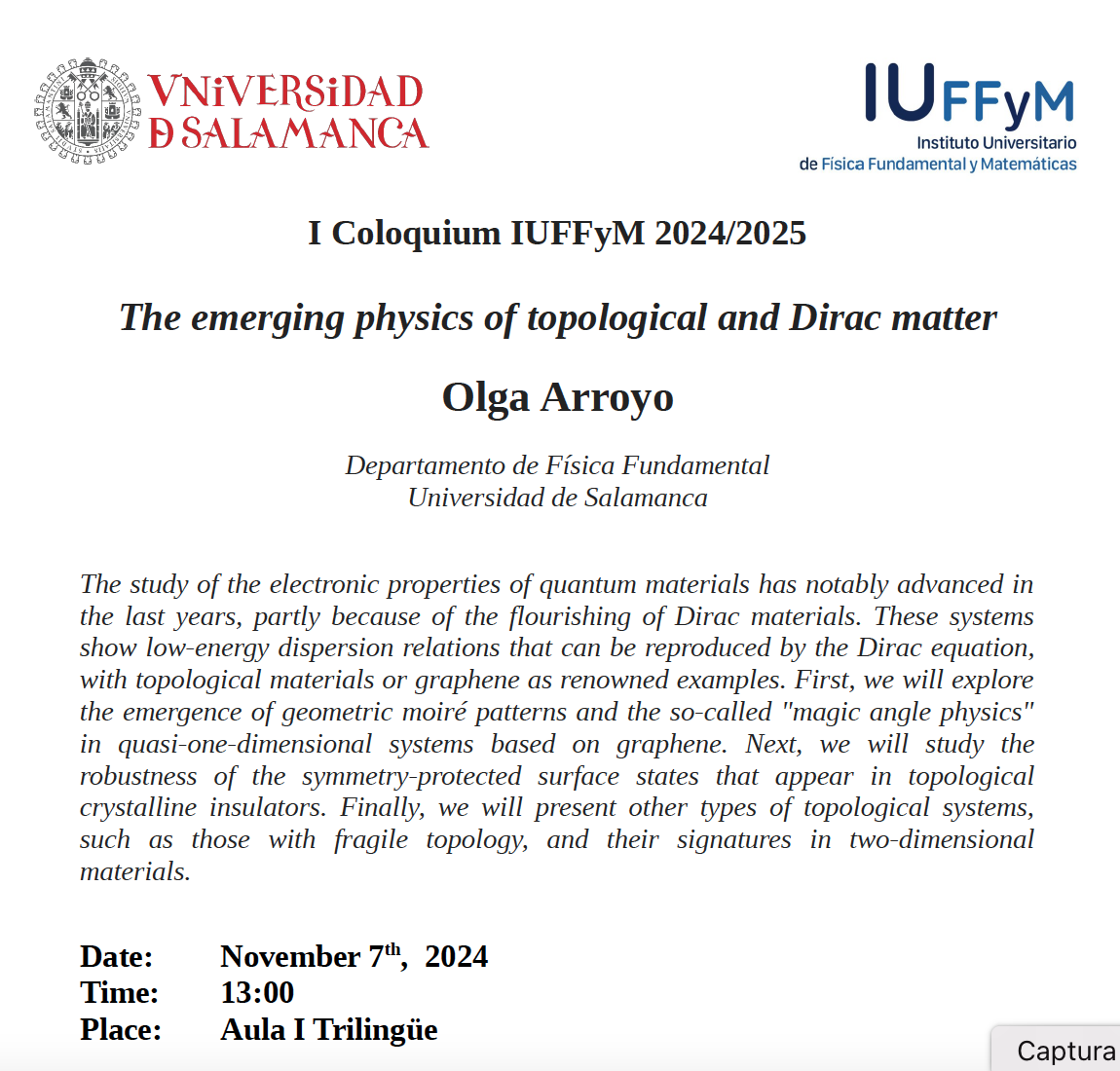
The emerging physics of topological and Dirac matter – Olga Arroyo

SemIUFFyMNov2024Dear all,

this is the announcement of our first colloquium next Thursday at 13:00 (see details below).
As always, coffee and some snacks will be offered at 12:30 next to the pendulum of Edificio Trilingüe (Facultad de Ciencias).
************************************************************
Title: The emerging physics of topological and Dirac matter
Speaker: Olga Arroyo
Departamento de Física Fundamental – Universidad de Salamanca
Abstract: The study of the electronic properties of quantum materials has notably advanced in the last years, partly because of the flourishing of Dirac materials. These systems show low-energy dispersion relations that can be reproduced by the Dirac equation, with topological materials or graphene as renowned examples. First, we will explore the emergence of geometric moiré patterns and the so-called “magic angle physics” in quasi-one-dimensional systems based on graphene. Next, we will study the robustness of the symmetry-protected surface states that appear in topological crystalline insulators. Finally, we will present other types of topological systems, such as those with fragile topology, and their signatures in two-dimensional materials.
Room: Aula I (Edificio Trilingüe, Facultad de Ciencias, Universidad de Salamanca)
Time: 13:00
Date: Thursday, November 7th.
****************************************************************************************************
We hope to see you there!
Comentarios { 0 }

3D models of nanoporous carbon materials

CarlaDeTomas

El próximo martes 24 de septiembre, a las 13:00h,  en el aula I del Edifico Trilingüe de la Facultad de Ciencias de la Universidad de Salamanca tendrá lugar el Seminario:

3D models of nanoporous carbon materials

a cargo de Carla de Tomas

Antigua alumna del Grado en Fisica que actualmente es:

Marie-Sklodowska Curie Individual Research Fellow

Department of Chemical Engineering

Imperial College London

Está organizado por el Instituto de Física Fundamental y Matemáticas de la Facultad de Ciencias (IUFFyM).

Comentarios { 0 }

Chang’E 6 y DORN: Abriendo nuevas fronteras en la exploración lunar

Ayer viernes, tuvimos la suerte de escuchar a Ignacio de Loyola Chacartegui Rojo en su conferencia en los Encuentros sobre Fronteras de la Ciencia (https://fronteras.usal.es/ponentes/):

Fronteras24_Chacartegui

Chang’E 6 y DORN: Abriendo nuevas fronteras en la exploración lunar.

El 3 de mayo de 2024, un cohete Marcha Larga 5 despegó desde Hainan, China, llevando la sonda Chang’E 6 a la Luna. Esta misión busca recoger, por primera vez, muestras lunares desde su lado oculto. A bordo, viajan instrumentos internacionales, incluyendo el DORN (Detection of Outgassing RadoN), un espectrómetro de partículas alfa para medir el gas noble radiactivo Radón. ¿Qué secretos esconde la Luna que aún no hemos descubierto? Estas misiones no tripuladas son los primeros pasos hacia la exploración humana del espacio, y allá en las fronteras de nuestro sistema planetario, se halla una de las fronteras de la ciencia.


Todos los asistentes a la charla, estudiantes del Grado en Física de la Universidad de Salamanca y de la Universidad de Valladolid, disfrutamos de esta aventura espacial guiados por Ignacio.

Muchas gracias

Comentarios { 0 }

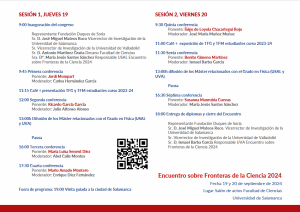
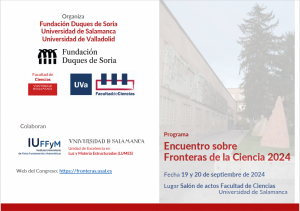
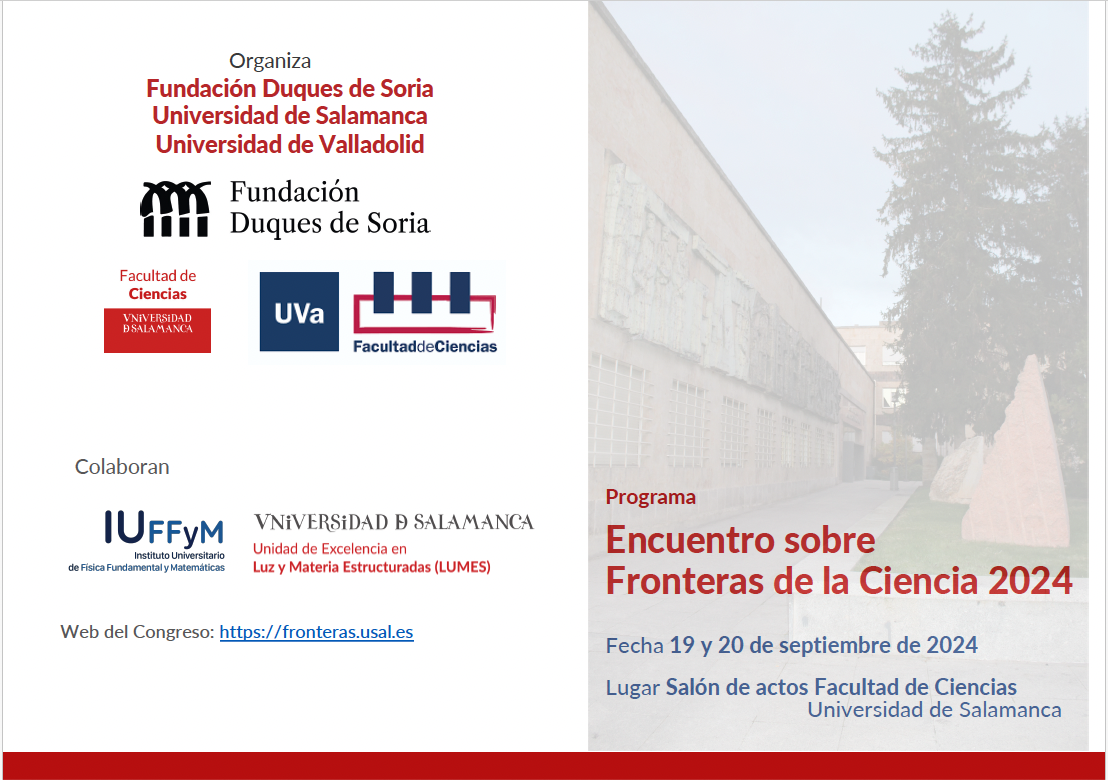
Encuentros sobre Fronteras de la Ciencia 2024 19-20 septiembre

19 y 20 septiembre se celebran en la Facultad de Ciencias los Encuentros sobre Fronteras de la Ciencia 2024. https://fronteras.usal.es/

La inscripción es totalmente gratuita gracias al apoyo dela Fundación Duques de Soria, la Universidad de Salamanca, la Universidad de Valladolid, el Instituto de Física Fundamenta y Matematicas (IUFFyM) y la Unidad de Excelencia en Luz y Materia Estructuradas (LUMES).

Nos acompañan profesionales punteros en diferentes ramas de la Física:

Fronteras2024b

  • Jordi Mompart,
  • Ricardo García García,
  • María Luisa Senent Díez,
  • Íñigo de Loyola Chacartegui Rojo,
  • Benito Gimeno Martínez y
  • Susanna Manrubia Cuevas.

Si te apasiona la Física ¡te esperamos!

Comentarios { 0 }
Política de privacidad
Studii Salmantini. Campus de excelencia internacional