


Title seminar: Modified gravity, generalized SU(2) Proca theory, and inflation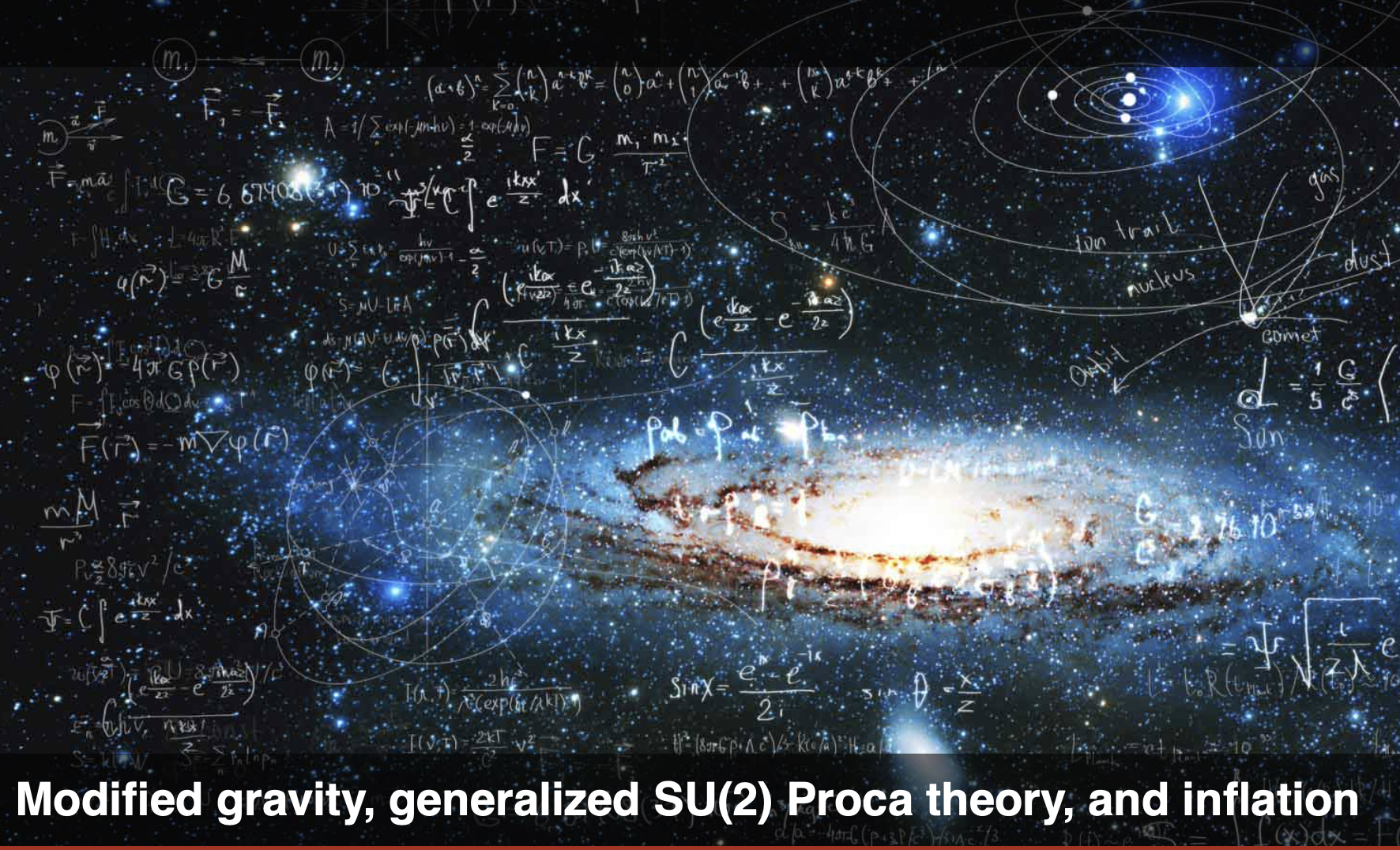
Speaker: Yeinzon Rodríguez García
Date and time: Tuesday, July 16th, (12:00)
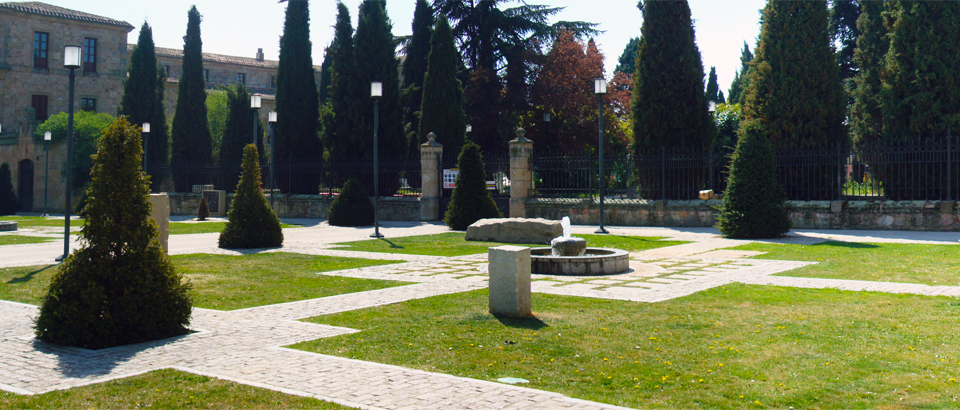
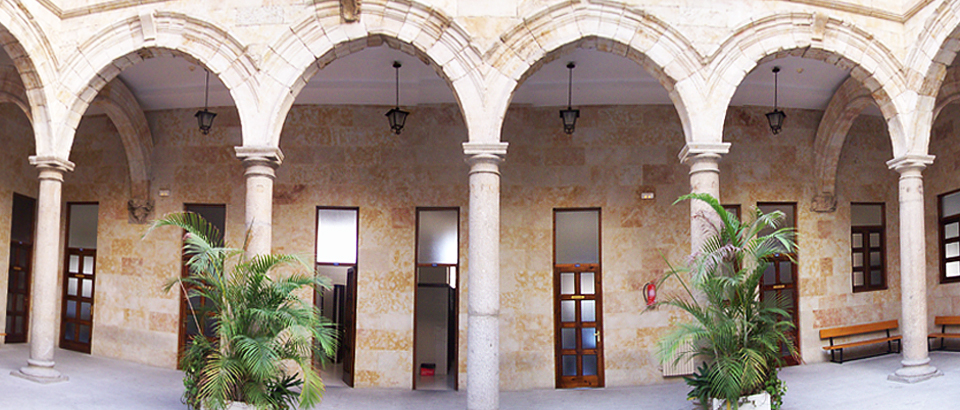
Room: Aula V (Edifício Trilingüe) – Facultad de Ciencias – Universidad de Salamanca
Universidad Industrial de Santander, Universidad Antonio Nariño.Abstract: This talk will be divided into three pieces. In the first part of the talk, I will introduce the common ideas surrounding the modified gravity proposals starting from their main motivation: Einstein gravity, despite all its success on the observational side, is an effective theory. In the second part of the talk, I will present the generalized SU(2) Proca theory (GSU2P for short). As a modified gravity theory that introduces new gravitational degrees of freedom, the GSU2P is the non-Abelian version of the well known generalized Proca theory where the action is invariant under global transformations of the SU(2) group. This theory was formulated for the first time in Phys. Rev. D 94 (2016) 084041, having implemented the required primary constraint to make the Lagrangian degenerate and remove one degree of freedom from the vector field in accordance with the irreducible representations of the Poincaré group. It was later shown in Phys. Rev. D 101 (2020) 045009 that a secondary constraint, which trivializes for the generalized Proca theory but not for the SU(2) version, was needed to close the constraint algebra. The implementation of this secondary constraint in the GSU2P was performed in Phys. Rev. D 102 (2020) 104066 where, as a side effect, the construction of the theory was made more transparent. Since several terms in the Lagrangian were dismissed in Phys. Rev. D 94 (2016) 084041 via their equivalence to other terms through total derivatives, not all of the latter satisfying the secondary constraint, the work was not so simple as directly applying the secondary constraint to the resultant Lagrangian pieces of the old theory. Thus, my collaborators and I were motivated to reconstruct the theory from scratch. In the process, we found the beyond GSU2P. In the third part of the talk, I will show what the impact of the GSU2P is on the cosmic primordial inflation epoch and what its main challenges are.
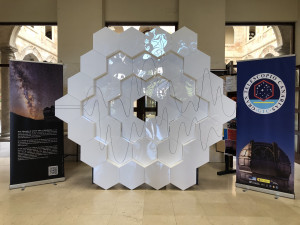 Hoy, al entrar en el Edificio Trilingüe de la Facultad de Ciencias de la Universidad de Salamanca nos hemos encontrado con una sorpresa:
 Salón de Actos del IRNASA-CSIC (C/Cordel de Merinas s/n),