European Researchers’ Night

6/10/25, 13:19

On Friday, 26th of September 2025 we participated in European Researchers’ Night that took place at La plaza del Oeste (Salamanca). For that occasion, Unidad de Cultura Científica y de la Innovación converted the square to an open-air laboratory aiming to bring research closer to audiences of all ages.

At this event my colleague David Domínguez Villar and I participated as Grupo de Investigación en Cuevas y Karst and tried in an interactive way to familiarize the visitors with karst landscapes and explain the processes of karst surficial landforms and caves formation.

20250926_191334

Research stay at Jožef Stefan Institute (Ljubljana, Slovenia)

25/07/25, 10:10

Last month I performed a research stay at the Department of Environmental Sciences of Jožef Stefan Institute in Ljubljana (Slovenia). This institute is the largest research institute in Slovenia. The main research areas are physics, chemistry, molecular biology, biotechnology, information technologies, reactor physics, energy and environment. I was hosted by a Prof. Dr. Sonja Lojen, Head of the Isotopic biogeochemistry group at Reactor Center Podgorica where research facilities and equipment are located.

The goal of the COSKA project is to explore the variability of CO2 concentration of karst underground not affected by forced ventilation and establish its relationship with soil CO2 signal. Therefore, each month in Eagle cave we collect water samples to analyse dissolved inorganic carbon (d13CDIC), while gas samples from the external, soil and cave atmospheres are collected to analyse carbon isotopes in CO2 (d13CCO2). During my research stay at Jožef Stefan Institute I analysed those samples using EUROPA-20 IRMS.

The institute’s Podgorica Reactor Center is as well home to a 250 kW TRIGA Mark II nuclear reactor and during my stay I was allowed to visit this facility while it was operating.

20241121_094334

International symposium “Man and Karst 2025″

24/07/25, 16:48

Karst landscapes, unique for their distinctive morphology, hydrology and wildlife, are extremely sensitive to climate changes and anthropogenic impact. Thus, in order to protect them, it is of great importance to understand their development and processes governing them. Dinaric karst is the locus typicus for karst geomorphology, with a long tradition of karst research in this area.

International symposium “Man and Karst 2025″ organised by Center for Karst and Speleology, Sarajevo  brought together numerous experts, scientists and enthusiasts from the field of speleology and karst research. The conference took place in Bihać (Bosnia and Herzegovina) from June 23 to 25, 2025, and included fieldtrips to Una National ParkVelika pećina and Hrustovačka pećina caves.

Krklec, K., Domínguez-Villar, D., Perica, D. (2025): Impact of lichens on rock weathering. International Symposium “Man and Karst 2025″ & ALCADI 2025 In memory of Andrej Mihevc, geographer, speleologist and karstologist: Programme, Excursion and Abstracts / Mulaomerović, J. & Agić, A. (eds.). Sarajevo: Center for Karst and Speleology, 48-48.


Jacob’s staff (Vara de Jacob)

28/06/25, 10:50

Jacob’s staff is a simple measuring instrument traditionally used in stratigraphy to measure the thickness of stratigraphic successions. This lightweight, portable tool makes it easier to determine the true thickness of rock beds, even when the outcrop’s configuration makes direct measurement difficult (e.g., covered outcrop).

We did a teaching innovation project (proyecto de innovación docente) at University of Salamanca:  “Incorporación de la Vara de Jacob en clases prácticas como herramienta introductoria al estudio cuantitativo y cooperativo en ciencias geológicas”. The project aims to help students, teachers, researchers or amateurs to learn how to use and/or make their own Jacob’s staff.

The plans and instructions can be freely downloaded in *PDF format from the institutional repository of the University of Salamanca accessible through the following link:

http://hdl.handle.net/10366/166169,

while more details can be found on the projects webpage:

https://varadejacob.usal.es/


4th Cave monitoring workshop

26/05/25, 14:02

Monitoring of cave environments has substantially expanded over the past decade in the wake of cave heritage preservation, speleothem-based paleoclimatology, hydrology and climatic change. Technological progress in the accuracy of sensors, in the automatization of measurements, and new developments coupled with new data reporting possibilities has opened large perspectives for a better understanding of underground processes, especially cave climate modeling and rainfall infiltration. Since investigation of COSKA project relies on collection (and later on interpretation and modelling) of accurate data in the cave, we participated in the 4th Cave monitoring workshop, held in Les Eyzies (Dordogne, France) on 6th and 7th of May 2025.

Discussion and presentation part of the Workshop was followed by a visit to two caves in the Pyrenees (Gargas Cave and Esparros Cave) where extensive cave monitoring work has been done and we were able to inspect and discuss monitoring equipment in situ.

Krklec Kristina, Domínguez-Villar David, Sonja Lojen, Željka Zgorelec (2025): Monitoring of cave atmosphere in Eagle Cave, Spain. 4th Cave monitoring workshop.

Domínguez-Villar David, Krklec, Kristina, Sonja Lojen (2025): Design of a diffusion well to sample soil CO2 for isotope analyses. 4th Cave monitoring workshop.

Snimka zaslona 2025-05-26 124915


10th International Climate Change, The Karst Record (KR10) Conference

29/04/25, 9:04

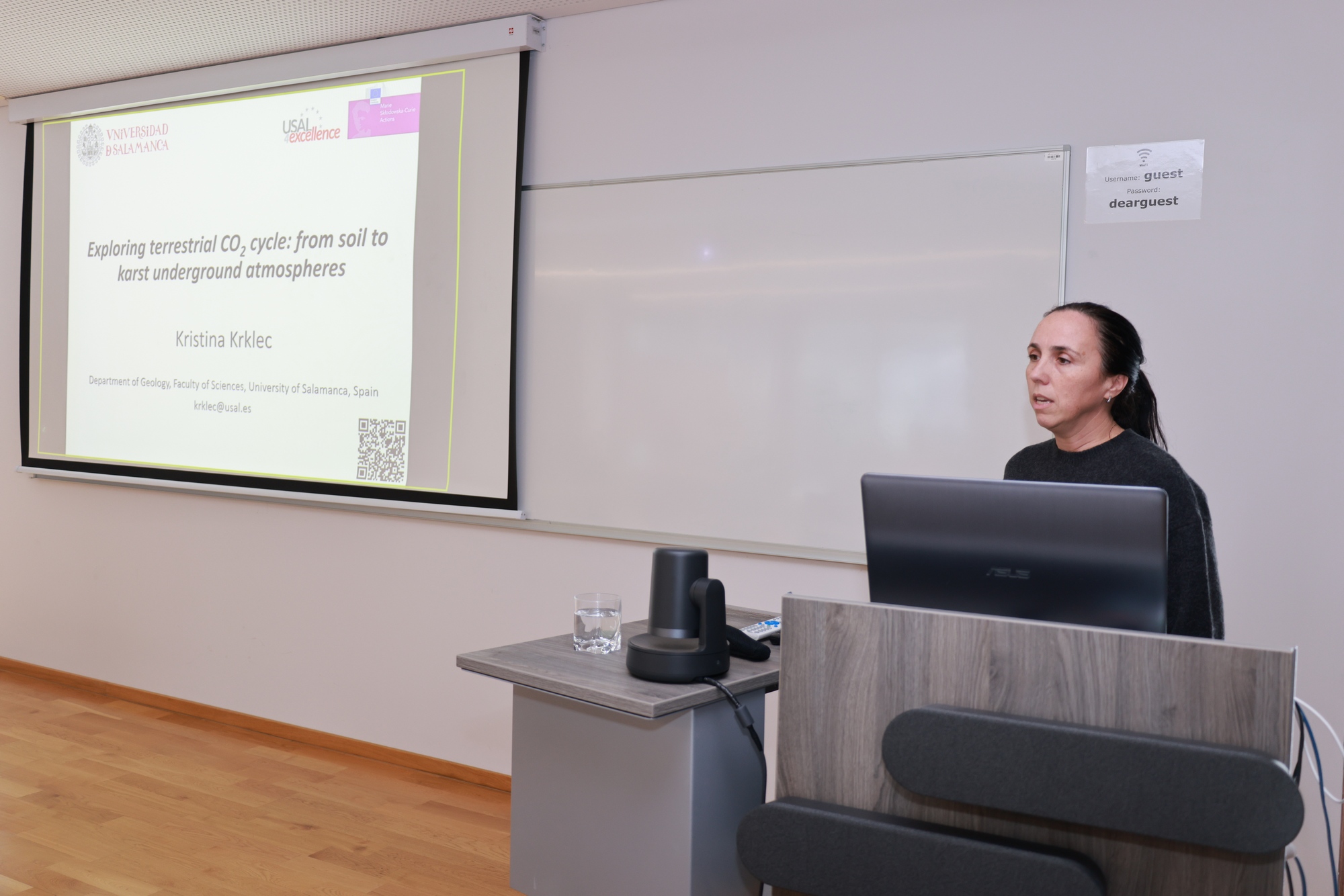
Recently we presented the research results of COSKA project at 10th International Climate Change, The Karst Record (KR10) Conference organised by the University of Cape Town (South Africa). This conference brought together scientists to share the latest progress in the rapidly developing field of cave- and karst-based (palaeo)climate research.
Main meeting took place at the University of Cape Town from 24-28 March 2025, while during the pre-conference excursion delegates visited the UNESCO World Heritage Site the Cradle of Humankind and Fossil Hominid Vault at the University of the Witwatersrand in Johannesburg.

Krklec, K., Domínguez-Villar, D. (2025): Cave ventilation dynamics in Eagle Cave (Spain) and controls affecting the cave air CO2 concentration. Abstracts, 10th International Climate Change: The Karst Record (KR10), 42-42.

DSC_0835

Mujeres Que Cambian la USAL – final gala

11/03/25, 9:42

On Wednesday, March 5th 2025 Juan del Enzina Theater hosted the final galla of the “Mujeres que cambian la USAL” program gathering 665 students, 34 teachers from 18 schools in Salamanca, Ávila and Zamora, and 63 researchers from the University of Salamanca. Here, 4th year ESO students from Colegio San Estanislao de Kostka – Salamanca (led by professor Juan Antonio Vicente García) presented their “Detectives del paleoclima” project that my colleague Diana Ochoa and me helped them to develop over the last few weeks.

Students did great work using paleontological data and karst development concepts to reconstruct the climate. At the final gala, three students presented the work and conclusions of this project reflected in an infographic that they have created from scratch. Well done!!

We hope that this experience managed to evoke the interest for scientific research among our students.


download   SELECCIONADA-235

Mujeres Que Cambian la USAL

22/01/25, 9:20

Last week my colleague Diana Ochoa and me held first talk of the “Women Who Change USAL” program at the St. Stanislaus Kostka College in Salamanca. This program is part of the celebration of the 2025 International Day of Women and Girls in Science. It aims to publicize the research being carried out of the university and to encourage scientific vocations among ESO students, especially girls, highlighting the participation of women in science.

We presented “Detectives del paleoclima” research project following the “Think C-cubed Challenge” format to 4th year ESO students of professor Juan Antonio Vicente García. In this project, after applying the scientific method, the students will have to solve a question using paleontological data and karst development concepts.

20250114_105820    Diana & Kris

XI Congreso Geológico de España (2024)

12/07/24, 10:25

Last week preliminary results of COSKA project were presented at 11th Geological Congress of Spain organized by the Geological Society of Spain (SGE), Spanish Geological Survey (IGME), and the Spanish National Research Council (CSIC). The congress inagurated in Ávila brougth together 700 specialists in Earth Sciences and it was a chance to celebrate 175th aniversary of IGME foundation.

Slide1 v2  Slide122  Domínguez-Villar et al._CGE24_Poster

Start of COSKA project

6/05/24, 9:45

COSKA project (Transfer of CO2 from soil to karst underground atmospheres) officially started on February 1st, and currently we are setting up the experiment to measure underground CO2 concentrations at Cuevas del Águila (Eagle cave) in Ávila province (Spain) where this research will take place.

DSC_0126-1024x680DSC_0211-1024x680