

For this entry, I would like to talk about what I and many others consider to be the best animation studio nowadays. Of course, I am referring to Studio Ghibli.
Studio Ghibli’s logo
History
The company is headquartered in the Japanese city of Koganei and has been running for almost 40 years. It was founded in 1985 by Hayao Miyazaki, Isao Takahata and Toshio Suzuki. The first two, both directors, had been working together for almost 20 years, and met Suzuki during the production of Nausicäa of the Valley of the Wind, the first original film directed by Miyazaki. After the success of the movie, they decided to set up their own studio with the financial support of the Tokuma Shoten publishing house.
Studio Ghibli’s first film, released in 1986, was Laputa: Castle in the Sky. Like Nausicäa, it was a huge success in Japan. In fact, it went on to become the highest-grossing animated movie of that year in the country. It also won the Anime Grand Prix of Animage magazine.
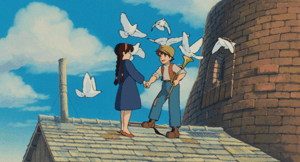
Laputa: Castle in the Sky
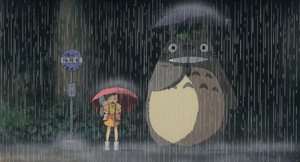
Two years later, My Neighbour Totoro was released. Although it was not as acclaimed as its predecessors at the time, nowadays it is one of Studio Ghibli’s most famous films. The image of Totoro, a spirit of Japanese folklore, can be found on all kinds of merchandising and even on the studio’s logo.
1999 saw the first contact of a Ghibli feature film with the US market. Princess Mononoke, released two years earlier, had become the highest-grossing film in Japanese history. Even though American audiences showed little interest in the movie, it helped to open the studio’s doors to the world.
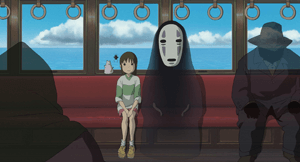
International success came in 2001 with Spirited Away, which managed to take Titanic‘s place as the highest grossing film in Japanese history, a position it would hold for 19 years, until the arrival of Demon Slayer in 2020. The critics are unanimous: it is one of the best animated films in history. This fact is reinforced by the best animated film Oscar it received in 2003. Fun fact: it is the only non-English language, hand-drawn animated film to have achieved this.
During the first decade of the century, Studio Ghibli continued to produce such iconic films as Howl’s Moving Castle and Ponyo. In 2014, Miyao Hayazaki announced his retirement, which led to the temporary closure of the studio. However, against all odds, Miyazaki returned in 2017 to direct a final movie, Kimitachi wa Dō Ikiru ka (in English, How do you live?), which is scheduled to be released this year.
The “Ghibli feel”
But what is it that makes Ghibli films so recognisable? They have a very specific art style: most of the frames are drawn and coloured by hand, with minimal help from technology. In addition, the colours have a quality that resembles paintings made with watercolours or acrylic paints. In terms of plot, these are some of the most common themes:
- The main characters are usually girls or young women who embark on a journey of personal development.
- Despite being made for children, they do not miss the opportunity to convey anti-war messages in favour of peaceful conflict resolution.
- They are set in a Japan (or other country, real or fantastical) where the progress of technology is leading to the loss of tradition. This is often linked to the destruction of biodiversity and the need to protect the environment.
My Top 3
To conclude this entry, I would like to list what I consider to be Studio Ghibli’s three best films.
- Porco Rosso: the story of a First World War Italian ex-soldier who has been turned into a pig and chases down air pirates.
- Grave of the Fireflies: two brothers try to survive during the last months of World War II in Japan.
- Howl’s Moving Castle: a cursed young girl runs away from home and turns to one of the most feared wizards of the country for help.
 English
 Español